
The global refining industry is rapidly evolving as energy companies seek sustainable alternatives to conventional petroleum-based fuel production. Growing environmental concerns, stricter emission regulations, and increasing investments in renewable energy infrastructure are transforming the operational strategies of refineries across the world. In this changing energy landscape, the co-refining market has emerged as a vital solution for reducing carbon emissions while maintaining fuel production efficiency.
Co-refining, often referred to as co-processing, involves processing renewable feedstocks alongside traditional crude oil within existing refinery systems. Renewable feedstocks may include biomass oils, used cooking oils, waste plastics, vegetable oils, animal fats, and other bio-based materials. Through co-refining technologies, refineries can produce cleaner transportation fuels such as renewable diesel, sustainable aviation fuel, biodiesel, and bioethanol without requiring the construction of entirely new refining facilities.
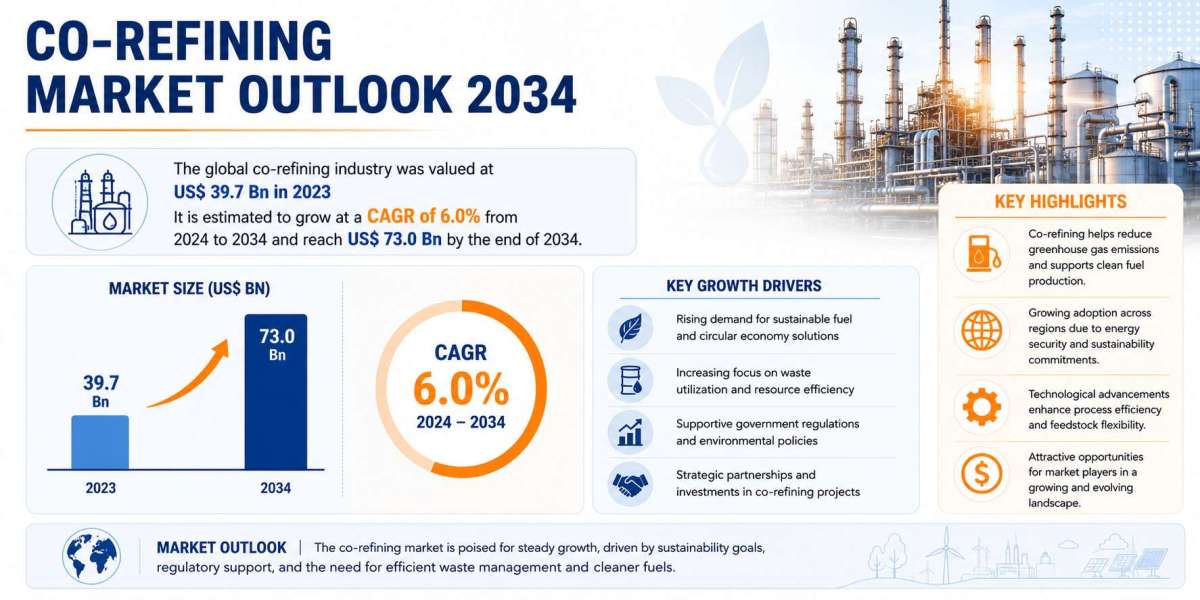
The global co-refining market was valued at US$ 39.7 Bn in 2023 and is projected to reach US$ 73.0 Bn by 2034, growing at a CAGR of 6.0% during the forecast period. The market’s expansion is being supported by the worldwide transition toward a low-carbon economy, increasing adoption of biofuels, and technological advancements in refining operations.
Evolution of the Co-refining Industry
For decades, petroleum refineries have served as the backbone of the global energy sector by converting crude oil into fuels and petrochemical products. However, mounting pressure to reduce greenhouse gas emissions has encouraged the industry to adopt more sustainable production methods.
Traditional refining processes are highly carbon-intensive and heavily dependent on fossil fuels. As climate change concerns intensify, governments and environmental agencies are introducing stringent regulations aimed at reducing emissions from transportation and industrial activities. This shift has prompted refineries to explore renewable alternatives that can be integrated into existing operations.
Co-refining has emerged as an effective and economically feasible solution because it allows refiners to gradually incorporate renewable feedstocks into conventional processing systems. Instead of investing in completely new bio-refineries, companies can modify existing infrastructure to accommodate renewable materials.
This strategy enables energy companies to minimize operational costs while accelerating the transition toward sustainable fuel production.
Transition Toward Cleaner Energy Sources
The global movement toward cleaner energy sources is one of the primary drivers of the co-refining market. Countries around the world are adopting ambitious climate goals designed to achieve carbon neutrality and limit global temperature increases.
The transportation sector remains among the largest contributors to greenhouse gas emissions. Road vehicles, aircraft, and shipping activities continue to consume massive quantities of fossil fuels, creating an urgent need for cleaner alternatives.
Co-refining technologies play a crucial role in addressing this challenge by enabling the production of low-carbon fuels using renewable feedstocks. Renewable diesel and sustainable aviation fuel produced through co-processing methods can significantly reduce lifecycle carbon emissions compared to conventional petroleum fuels.
In addition, refiners are increasingly integrating renewable hydrogen and carbon capture technologies into operations to further reduce environmental impact. Investments in low-carbon refining solutions are expected to continue rising as governments strengthen decarbonization policies.
The gradual shift toward electric vehicles is also influencing refinery strategies. As long-term demand for gasoline declines, refiners are diversifying operations and focusing on renewable fuel production to remain competitive in the future energy market.
Growing Demand for Biofuels
The increasing global demand for biofuels is another key factor driving growth in the co-refining market. Biofuels are widely recognized as one of the most practical solutions for reducing emissions in sectors where electrification remains difficult.
Heavy transportation, aviation, and maritime industries require high-energy-density fuels that cannot easily be replaced by battery-powered alternatives. As a result, renewable fuels produced through co-refining are becoming increasingly important.
Sustainable aviation fuel is attracting particularly strong attention from airlines and aviation regulators worldwide. Airlines are under pressure to reduce carbon emissions and meet international climate commitments. Co-refining technologies allow refineries to produce SAF using renewable feedstocks such as used cooking oil and vegetable oils.
Similarly, renewable diesel and biodiesel are witnessing rising demand in road transportation due to stricter fuel emission standards and government blending mandates.
The growing popularity of biofuels is also improving energy security by reducing dependence on imported crude oil. Countries with limited fossil fuel resources are investing in domestic renewable fuel production to diversify energy supplies and strengthen economic resilience.
Importance of Feedstock Diversity
One of the major advantages of co-refining is its ability to process multiple feedstock types. This flexibility enhances operational efficiency and allows refiners to adapt to changing market conditions and resource availability.
Crude Oil Co-refining
Crude oil co-refining remains the dominant market segment because existing refineries are already designed around petroleum processing infrastructure. In this approach, renewable feedstocks are blended with conventional crude oil during refining operations.
This method allows companies to lower carbon emissions incrementally while minimizing infrastructure costs.
Biomass Co-refining
Biomass co-refining is gaining traction due to the increasing availability of agricultural waste, forestry residues, and bio-based oils. Biomass materials can be converted into renewable fuels through hydroprocessing and other advanced refining techniques.
The use of biomass feedstocks supports waste reduction while promoting sustainable resource utilization.
Waste Plastic Co-refining
Plastic waste management has become a major global challenge. Waste plastic co-refining technologies offer an innovative way to convert discarded plastics into useful fuel products.
Processes such as catalytic cracking and pyrolysis break down plastic waste into hydrocarbons that can be processed within existing refinery systems. This approach contributes to circular economy objectives and reduces environmental pollution.
Renewable Feedstock Co-refining
Renewable feedstocks including used cooking oils, animal fats, and vegetable oils are increasingly being used in renewable diesel and SAF production. These materials are attractive because they can often be processed with relatively minor refinery modifications.
As feedstock supply chains improve, renewable feedstock co-refining is expected to witness significant growth in the coming years.
Technological Innovations Driving Market Growth
Technological advancements are playing a central role in the expansion of the co-refining market. Refiners are continuously developing and optimizing processes to improve fuel quality, increase conversion efficiency, and reduce operational costs.
Hydroprocessing
Hydroprocessing is among the most widely used co-refining technologies. The process involves treating feedstocks with hydrogen under elevated temperature and pressure conditions to remove impurities and improve fuel characteristics.
Hydroprocessing is highly effective in converting renewable oils into renewable diesel and sustainable aviation fuel.
Catalytic Cracking
Catalytic cracking is commonly used to convert heavy hydrocarbons into lighter fuel products such as gasoline and aviation fuel. The process is also highly suitable for converting waste plastics into valuable hydrocarbons.
Compared to some alternative methods, catalytic cracking offers lower energy consumption and greater operational flexibility.
Fluid Catalytic Cracking (FCC)
Fluid catalytic cracking units are critical components of modern refineries. These systems convert heavy petroleum fractions into gasoline, olefins, and petrochemical feedstocks.
FCC units are increasingly being adapted for renewable feedstock processing, making them essential for co-refining operations.
Hydrotreating
Hydrotreating removes sulfur, nitrogen, and other contaminants from feedstocks and fuel products. The process helps refiners comply with strict environmental regulations governing fuel quality and emissions.
Demand for hydrotreating technologies is expected to rise as sulfur emission standards become more stringent worldwide.
Hydrocracking
Hydrocracking is a more advanced refining process that breaks down heavy hydrocarbons into lighter and cleaner fuel products. The process improves fuel yields and enhances product quality while reducing environmental impact.
Continuous improvements in catalyst performance are expected to further strengthen hydrocracking efficiency in future co-refining applications.
Europe Maintains Leadership Position
Europe accounted for the largest share of the global co-refining market in 2023. The region’s leadership can be attributed to strong environmental policies, renewable energy targets, and significant investments in clean fuel technologies.
The European Union has introduced ambitious climate mitigation strategies aimed at reducing transportation emissions and increasing renewable fuel usage. Biofuel mandates and carbon reduction policies are encouraging refineries to accelerate renewable feedstock integration.
Europe also has well-developed waste collection and recycling systems, which support the availability of feedstocks such as used cooking oil and waste plastics.
Furthermore, substantial investments in carbon capture and storage projects are supporting the development of sustainable refining technologies throughout the region.
The increasing production and adoption of sustainable aviation fuel are expected to further strengthen Europe’s position in the global co-refining market.
North America and Asia Pacific Emerging as Key Growth Regions
North America is witnessing rapid growth in renewable fuel investments, particularly in the United States. Government initiatives supporting hydrogen development, renewable diesel production, and carbon reduction technologies are creating favorable conditions for market expansion.
Several refinery operators in the region are upgrading facilities to process renewable feedstocks and increase low-carbon fuel production capacity.
Meanwhile, Asia Pacific is emerging as a highly promising market due to rising industrialization, urbanization, and transportation fuel demand. Countries such as China, India, and Japan are investing heavily in refinery modernization and renewable fuel infrastructure.
Increasing awareness regarding environmental sustainability and plastic waste management is also encouraging adoption of co-refining technologies across the region.
Competitive Landscape and Strategic Developments
The global co-refining market is highly competitive and includes major oil companies, national energy corporations, and technology providers.
Leading market participants are focusing on expanding renewable fuel capabilities through refinery upgrades, strategic partnerships, and technological innovation. Sustainable aviation fuel production has become a major area of investment due to rapidly growing demand from the aviation sector.
Companies are also investing in advanced catalyst systems and feedstock conversion technologies to improve operational efficiency and fuel quality.
Research and development activities are expected to intensify as refiners seek cost-effective methods for integrating renewable feedstocks into existing operations.
Challenges Limiting Market Expansion
Despite strong growth potential, the co-refining market faces several challenges. Feedstock availability and price volatility remain major concerns for refinery operators.
Competition for renewable feedstocks from food and chemical industries may impact supply stability. In addition, certain bio-based materials can present technical challenges during processing, requiring specialized catalysts and refinery modifications.
High capital investment requirements for refinery upgrades may also limit adoption among smaller market participants.
Regulatory uncertainty and inconsistent renewable fuel policies in some regions could affect long-term investment planning.
However, ongoing technological progress and supportive government initiatives are expected to help address these challenges over time.
Future Outlook of the Global Co-refining Market
The future of the co-refining market appears highly optimistic as industries worldwide accelerate efforts to reduce carbon emissions and transition toward cleaner energy systems.
Demand for renewable diesel, sustainable aviation fuel, and bio-based chemicals is expected to increase significantly over the next decade. Co-refining technologies provide a scalable and cost-efficient solution for meeting this demand while utilizing existing refinery infrastructure.
Advancements in hydroprocessing, catalytic cracking, hydrogen production, and carbon capture systems are likely to improve operational efficiency and economic viability.
In addition, circular economy initiatives promoting waste plastic recycling and biomass utilization will create new opportunities for market growth.
As governments continue implementing climate policies and renewable fuel mandates, co-refining is expected to become an increasingly important part of the global energy transition.
The market is poised for substantial innovation, investment, and expansion as refiners adapt to the future of sustainable fuel production.









